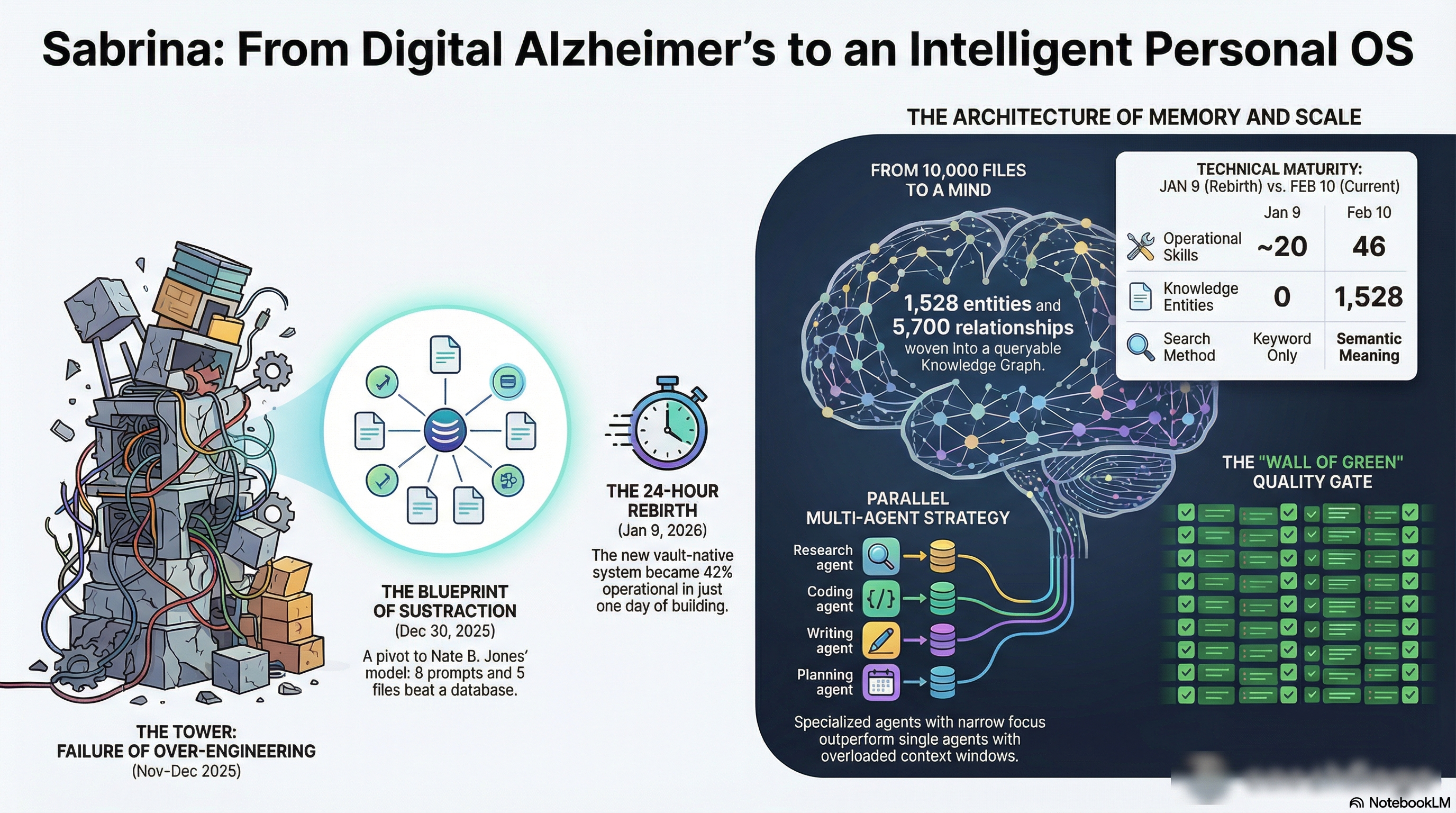
A living narrative of ambition, failure, discovery, and the elegant simplicity that changed everything.
The Drowning Man
November 2025It was November 2025, and Jeff McCracken was drowning.
Not in water. In information.
Every morning, his inbox overflowed with emails—each one a Pandora's box of hidden tasks, forgotten commitments, and urgent requests buried beneath corporate pleasantries. Voice notes from his walks piled up like autumn leaves, captured insights he swore he'd process “later.” Meeting notes from last Tuesday? Somewhere in a folder. That brilliant idea from the shower? Lost to the steam.
Jeff wasn't lazy. He was a consultant, an investor, a product manager—a man who'd spent two decades wrangling enterprise-scale systems for one of the largest utility companies in North America. He had apps. So many apps. Task managers and note-takers and calendars that synced and tools that promised to “revolutionize productivity.”
None of them remembered anything.
He'd start a conversation with an AI, explain his entire project, get brilliant advice—and then close the window. Gone. The next day, he'd explain everything again. And again. And again.
“I don't need another productivity app,” he muttered one evening, staring at his screen. “I need a person. Someone who remembers. Someone who can actually help.”
What he needed was impossible. Or so he thought.
The vault sat on his MacBook like a patient librarian—ten thousand markdown files, carefully organized into numbered folders. A decade of thinking. Meeting notes, investment research, project plans, voice transcripts, daily journals. All of it beautifully filed and absolutely inert.
The itch started simple: What if the vault could think?
Not in the hand-wavy AI-will-save-us way. In the specific, practical, I've-been-building-enterprise-systems-for-twenty-years way. What if you could talk to your notes? What if your calendar knew about your projects? What if the machine could read your email, check your portfolio, draft the response, and have it waiting for you before coffee?
They called her Sabrina. Professional but approachable. Capable but not cold. Like a person you'd actually want working for you.
She didn't exist yet. But she would.
The Tower
November 15, 2025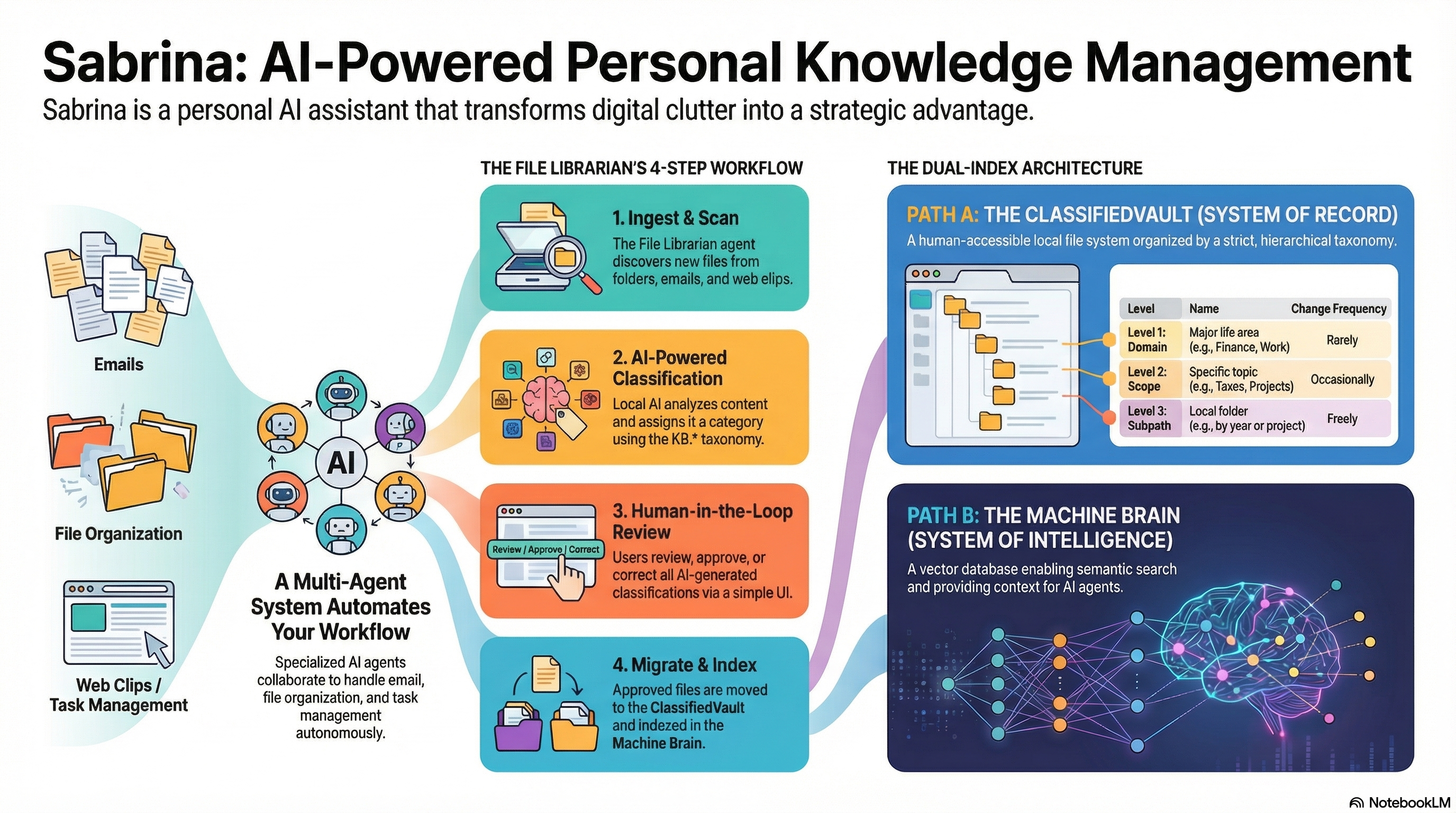
Jeff didn't just want an AI assistant. He wanted to build the future.
On November 15th, at exactly 1:38 PM Pacific time, he typed the words that would launch two months of furious ambition:
git commit -m "Initial commit: Sabrina Personal AI Assistant"The vision was audacious, documented in a file called VISION.md: an AI-powered Chief of Staff that would master his email, optimize his calendar, synthesize knowledge across all his sources, make proactive recommendations, and execute tasks with just a human thumbs-up. A five-year plan. A digital extension of his own mind.
And so he built. If you're going to build an AI assistant, you need infrastructure. Lots of infrastructure.
Jeff dove in headfirst. Over the next few weeks, he constructed an architectural marvel: A sleek frontend inspired by the macOS Mail app—dark-themed, sidebars and modals and status widgets. A backend serving up endpoints for email processing, task management, and knowledge retrieval. A team of specialized AI agents orchestrated through a graph framework—the Email Agent parsed incoming messages, the Scheduling Agent negotiated for optimal time blocks, the File Librarian classified documents, the Multi-Model Agent routed different questions to different AIs.
Memory? Dual-storage—a relational database for structured data, semantic search for documents. Deployment? Containers ready for the cloud.
The commit history tells the tale of frenzied creation:
Nov 15 13:50 — Add project summary and documentation
Nov 16 20:12 — Motion AI integration for intelligent scheduling
Nov 17 00:06 — Agent orchestration, RAG indexing
Nov 17 14:23 — Chat interface
Nov 18 09:15 — Dark theme implementation
Nov 19 22:47 — Database migration
By Thanksgiving, the prototype could fetch emails, analyze them for objectives, create action plans, schedule tasks, and present results through a beautiful web interface.
Jeff had built a tower. He just didn't realize it was Babel.
The Cracks
December 2025The first sign of trouble was the sync.
Two task systems working in harmony—that was the plan. Tasks would be created in one for storage, synced to another for scheduling, then synced back when completed. In theory: elegant. In practice: a nightmare.
Tasks duplicated. Completion status conflicted. Due dates drifted. Jeff spent more time debugging the sync than actually doing his work. The very tool meant to save him time was costing him time.
Then came the context problem—the same curse he'd been trying to escape.
He'd have a productive session with Sabrina. Great conversation! Clear action items! And then… the server restarted. Or he closed the browser. Or just came back the next morning.
Gone.
Sabrina didn't remember. She couldn't. Each conversation started fresh, like meeting a stranger who happened to have access to your files. The web application was sophisticated. It was professional. It was impressive.
And it sat there, unused, while Jeff went back to manually managing his inbox.
December brought a second approach. “Maybe the problem is storage,” Jeff reasoned. “Maybe I need relationships, not just files.” A knowledge graph. Instead of just filing documents, this version would understand them. Extract entities. Map connections. Build a web of knowledge.
Ask “Who have I been emailing about copper mining?” and the system would traverse the graph, finding connections between people, companies, and projects that even Jeff had forgotten.
It was beautiful, conceptually. A graph database holding the shape of his mind. But every piece required care—updates, restarts, debugging. Jeff was supposed to be getting work done. Instead, he was maintaining infrastructure.
The experiment proved one thing: intelligent classification worked. The concept was sound. The execution was exhausting.
By Christmas, both Sabrinas—the web application and the knowledge graph—sat idle. Monuments to ambition. Testaments to complexity.
And Jeff was still drowning.
The Man With the Blueprint
December 30, 2025
It was five days before the new year when Jeff stumbled across an article that would reshape everything.
“Grab the Delegation Kit I Use to Turn AI into my Chief of Staff.”
The author was Nate B. Jones—a guy who wrote about AI with the practical focus of someone who actually used it, not just philosophized about it. His opening hit Jeff like a punch:
Jeff knew this feeling intimately. He'd built an entire multi-agent web application trying to solve it.
But Nate's solution was different. Radically different.
No web app. No database. No deployment pipeline. Just prompts, files, and clear boundaries.
Eight prompts, each with a specific job: clarify intention, translate chaos into tasks, generate work orders, deliver morning briefings, process meetings, run weekly reviews, close out the day, maintain memory across sessions. And five files in a folder:
/chief-of-staff/
  CLAUDE.md        — Who I am, what I know, how I work
  INBOX.md         — Unprocessed items
  PROJECTS.md      — Active work with next actions
  WAITING_FOR.md   — Things delegated to others
  DECISIONS.md     — What got decided and why
That was it. The entire architecture.
No servers. No containers. No sync nightmares. Just markdown files that the AI could read at the start of every conversation—giving it memory through the simplest possible mechanism: text on disk.
But the real genius was the authority boundaries: zones where the AI could act freely, zones where it had to ask first, and zones where it was absolutely prohibited. This solved the trust problem. You could delegate because the limits were explicit.
Jeff read the article three times. Then he read Nate's entire delegation kit—all 62,000 tokens of it.
That night, Jeff couldn't sleep.
He kept thinking about the months he'd spent building infrastructure. The frontend components. The API routes. The agent orchestration. The database schemas. The container configurations. The cloud deployments.
All of it designed to solve one problem: AI that remembers.
And here was Nate, solving the same problem with… files.
Just files.
What if the solution wasn't more features, but fewer?
As 2025 ended and 2026 began, Jeff made a decision. The web application was set aside—preserved but inactive. The knowledge graph experiment shelved.
A new Sabrina was about to be born.
The Rebirth
January 9, 2026No frontend this time. No backend. No containers, no cloud deployment, no database.
Just a folder structure:
/chief-of-staff/
  CLAUDE.md
  INBOX.md
  PROJECTS.md
  WAITING_FOR.md
  DECISIONS.md
  prompts/
  history/
And three hooks—small programs that would run automatically every time a session ended. One logged everything. One routed content to the right history folder. One tracked parallel work.
The key insight—learned from months of failed complexity—was elegant: “Work normally. Documentation handles itself.” No manual session logging. No discipline required to maintain context. Just hooks running silently in the background, capturing every conversation, routing insights to history, building memory without effort.
By end of day one, Sabrina had a skeleton. She didn't have a soul yet. But she was real—in a way the web application had never been.
The next day was the Cambrian Explosion. In a single sustained session, the nervous system came online: seven prompts became operational, the intelligence pipeline (task extraction, priority scoring, duplicate detection) went live, and the task management connection was established—simplified to one system instead of two-system sync nightmares.
Forty-two percent might not sound impressive. But consider: the web application had taken two months to reach “demo-able.” This Sabrina was useful on day two.
The architecture decisions crystallized early. The task problem that had nearly paralyzed the web app—which system is the source of truth?—got a clean answer: one system schedules, one system remembers. No sync conflicts. No ambiguity.
Then came the first real test. Twelve files sat in the unclassified folder—voice notes, meeting transcripts, documents of uncertain origin. The exact use case the knowledge graph had been designed for. But this time it happened without a graph database: read each file, classify by content, route to the correct folder, extract tasks, create action items, update the project tracker. Twelve files processed. Zero manual intervention. Complete audit trail.
By mid-January, 212 Readwise articles needed processing. The volume was impossible for manual review. So Sabrina proposed something elegant: pre-scan everything, classify it, generate one editable markdown file where Jeff could make all 212 decisions at his own pace with single-character codes. One file. All decisions. No conversation fatigue.
The entire backlog became manageable in a single afternoon.
Three Roads, One Map
January 22, 2026By the third week of January, the landscape had gotten complicated—in the way that happens when a builder keeps building before pausing to count the buildings.
Three separate systems existed:
The Trading System—a full-stack investment platform with forty-one services covering everything from watchlist management to broker integration. Jeff had been building it for months. It was 60% done and 0% functional. The kind of project that's always almost finished.
Sabrina the App—the original web application with AI agents and a chat interface. Dormant since December. Forty percent built, zero percent running.
Sabrina the Vault—the Obsidian vault with Claude Code as the brain. Skills, history, hooks, files linking to files. This one worked.
The realization landed like a dropped wrench on a quiet shop floor: Only the vault-native version actually does anything useful. The apps were ambitions; the vault was reality.
And then the insight that changed everything: Build Sabrina first. Then use Sabrina to build everything else. The tool would build itself.
The same day, Jeff made another call. The interface question that had seemed secondary became fundamental: How should a human talk to their AI?
He chose voice. Not because it was easiest to build—it wasn't—but because it was the only interface that truly disappears. A keyboard sits between you and your thoughts. Voice just lets you think out loud.
And on that same crowded day, three input streams had been broken for days. Readwise articles piling up. Emails starring themselves with no one to triage them. Meeting notes dropped into the unclassified folder like orphans.
Jeff could have fixed them sequentially. Instead: “Launch five agents. Right now. One for each problem.”
Ten minutes. Five agents. Five reports. No context pollution between any of them.
The parallel attack proved something that would become core philosophy: specialized agents with narrow focus beat one general agent with everything in its head. Context windows aren't prisons if you don't try to shove everything into one cell.
Somewhere in the middle of the parallel attack, a quieter thought surfaced: Who's writing this down?
Not the code. Not the commits. The story. The Historian skill was born—an agent whose sole job was to capture the narrative. The irony wasn't lost on anyone: the AI was documenting its own construction.
The Infrastructure Revolution
January 23–31, 2026The parallel attack opened the floodgates. What happened in the next eight days would have taken most teams a quarter.
The flat-file approach had been fine for prototyping. But when five agents try to write to the same file simultaneously, you get silent corruption. A real database went live—thirty-five tables, a migration framework, and a notification system that let agents talk to each other through the database itself.
A personal OS running on a single machine in a home office is one power outage away from being a personal nothing. Cloud deployment went live—database syncing nightly, failover switching with a single command.
Six hundred sixty-six contacts imported from Google. Not just names and numbers—relationships. Who works where, who's connected to whom. “Who is [name]?” became a question with a real answer.
Semantic search across 10,500 documents. Not keyword matching—meaning matching. Ask “how does authentication work?” and get relevant results even if no file contains those exact words.
Skills firing on a timetable. Daily briefings at dawn. Task sync twice daily. Inbox triage in the morning. Weekly review on Sundays. All without drama.
The mobile app compiled. Push a button, say what you need, hear the answer. The dream breathing for the first time—natural conversation with centralized intelligence.
A maintenance agent that pings everything every five minutes, runs a deep health check at dawn, and sends alerts when things go wrong. Invisible when working. Essential when not.
Eight days. Database, cloud, contacts, search, scheduling, voice, monitoring. The equivalent of laying plumbing, wiring electricity, installing windows, and hanging a front door—all in the same week.
What She Became
February 1, 2026Eleven weeks from Nate's blueprint to… this.
What Sabrina had become by February wasn't a dashboard or an API or a collection of markdown files. It was a way of working. Jeff would sit down with coffee, say “good morning,” and Sabrina would tell him what happened overnight, what's on his calendar, what emails need attention, and what his portfolio did while he slept. Not because she was programmed to—because she knew enough to know what he'd want to know.
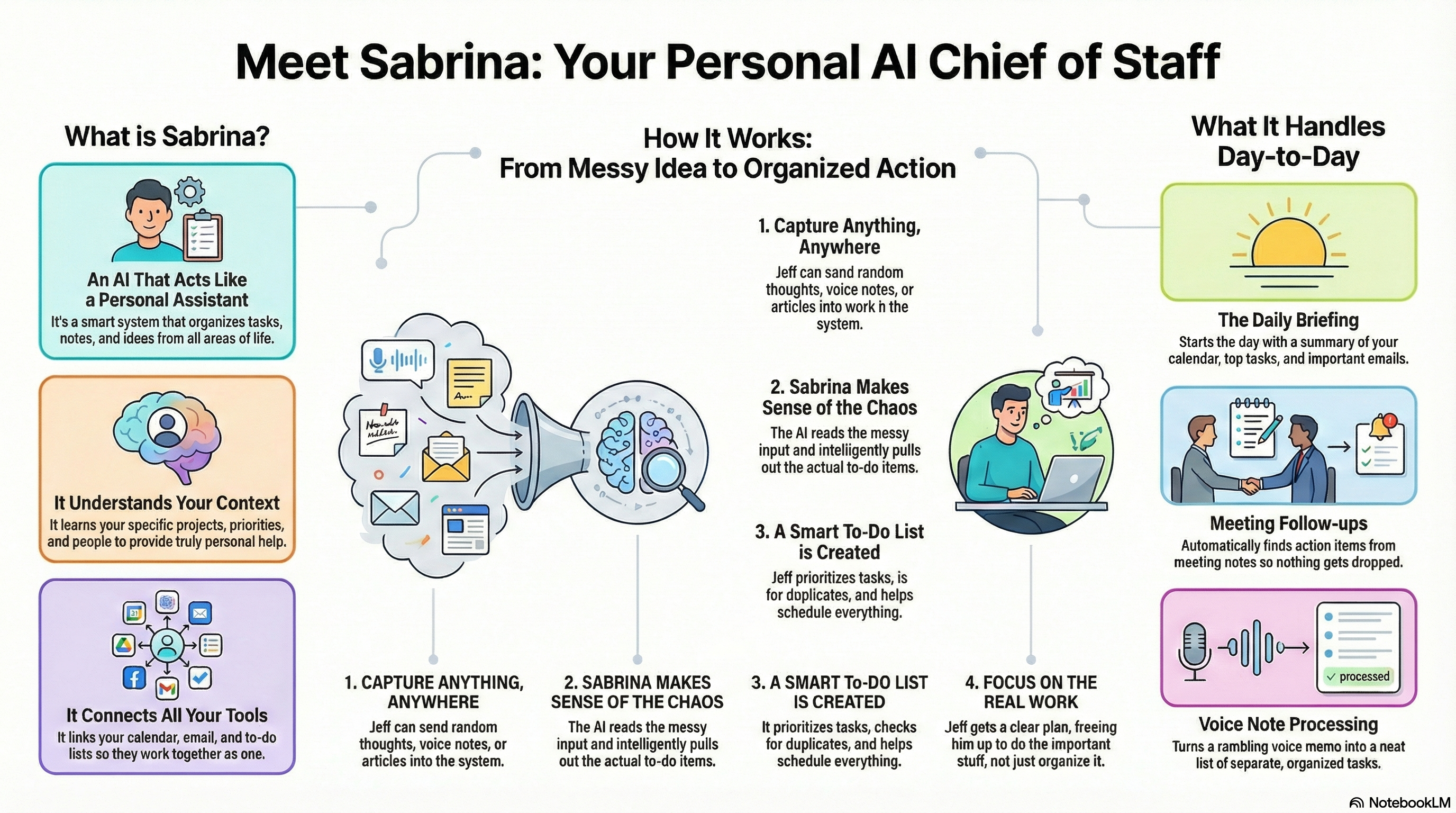
Sabrina: from messy input to organized action.
The vault-native simplicity hadn't been abandoned. It was augmented. Enterprise infrastructure wrapped around an elegant core, like a racing engine in a handbuilt chassis.
The original insight still held: memory beats intelligence. A system that remembers everything about your world is more valuable than a smarter system that starts fresh every conversation.
But now it had infrastructure to match the ambition.
And somewhere out there, Nate B. Jones was writing more articles about context engineering and delegation math—not knowing that one of his readers had turned the theory into a running system that would stand on stage at his own conference in six weeks.
The Proving Ground
February 1–8, 2026The infrastructure was impressive. But infrastructure is a promise, not proof. February would be about proving the machine actually worked—and finding everything that didn't.
The Voice Demo That Wasn't Quite Right
Branson called—the friend from the Clemson water ski team, the one who keeps showing up at every technology inflection point for the last thirty years. They'd built PCs from components in a college apartment in 1992. Started separate internet companies in 1995. Now they were talking about AI voice interfaces.
He wanted to see Sabrina in action. The demo went like most demos: impressive in concept, humbling in execution. The push-to-talk button didn't sync with the listening state. Users couldn't tell when Sabrina was ready to hear them. The timing was “janky”—Branson's word, diplomatic but accurate.
Three days of fixes. Button states synchronized. Visual feedback redesigned. And the biggest upgrade: the text-to-speech got replaced with something that sounded almost human.
The Wall of Green
On February 5th, something remarkable happened: the test count went from 68 to 1,451 in a single sprint. Not padding. Real coverage across twenty-one services, catching type mismatches between databases, edge cases hiding in plain sight, assumptions that only worked on one machine.
The codebase went from “probably works” to “provably works.” In a system being built partly by AI agents, that distinction isn't academic—it's survival.
Cleaning Day
February 7th was Sabrina's Marie Kondo moment.
Five work orders that had been sitting in “deferred” status got the treatment they deserved: permanent rejection. Projects that sounded interesting but weren't going to happen. Features that solved problems nobody actually had.
The backlog got lighter. The roadmap got honest. Every remaining item was real intent, not wishful thinking.
The Sprint That Found 43 Ghosts
Wave 4 Sprint, February 8th. The goal was to verify what was actually built versus what the roadmap said was built.
The surprise: forty-three components existed in the code that had never been tracked on the roadmap. PDF reading, context engineering patterns, market intelligence, testing frameworks—all built, all working, all invisible to the tracking system. The roadmap jumped from 71% to 93% complete. Not because of new construction, but because someone finally walked through the building and counted all the rooms.
Sabrina Meets the World
February 8–10, 2026Something shifted on February 9th. It wasn't a technical milestone or a code commit. It was a phone call. Then another. Then three more.
The Accounting Firm
Bill—Jeff's business partner for the new AI venture—had just closed the biggest deal of his career. And on the call with Jeff, he said the sentence that changed everything: “Show Brian what Sabrina can do.”
Brian was the firm's tech person. Google Workspace environment, comfortable with technology but not deep in AI. Jeff demoed Sabrina. Calendar management, email triage, document creation, voice interaction, the knowledge graph that could answer questions about anything in the vault. Brian's reaction was the kind that doesn't need words—it was the pause before he said, “How do we get this?”
The Concierge
Dena had a different vision: an elder care concierge service. Families who needed someone to manage doctor appointments, pharmacy coordination, legal paperwork, vendor relationships. Sabrina could be the backend—client management, appointment scheduling, document generation. The elder care market didn't know it needed AI. Dena knew it needed this AI.
The Thirty-Year Pattern
And then there was Branson. The call went long—the way calls always go when two builders who've known each other since college start talking about what's possible. He was running his own Sabrina fork, adapting it for his own world. He was also writing a book—a technology memoir—using writing skills he'd built into the system. An AI helping write a book about technology's excesses. The irony was beautiful.
The Real Estate Broker
Rachel—Jeff's partner—already had her deployment planned. Deal management, lease analysis, financial modeling. A valuation tool was already live. Her world was about to get a Chief of Staff too.
What Changed
In forty-eight hours, Sabrina went from a personal productivity tool to a product with four potential deployments. Jeff the builder had become Jeff the platform architect. And Sabrina—the Chief of Staff who was supposed to just manage his inbox—was becoming a business.
The Memory Graph
February 10, 2026Every system has a moment when it crosses from “collection of features” to “something that understands.” For Sabrina, that moment was the knowledge graph.
The graph had been running for weeks. But on February 10th, it crossed a threshold: 1,528 entities and 5,700 relationships, woven from the vault and the codebase. Not just documents linked to other documents. Understanding linked to other understanding.
“What's the relationship between the database migration and the February sprint?” A keyword search would find files containing both terms. The knowledge graph understood that one enabled the other—that the migration created the foundation that the sprint validated.
The same day brought housekeeping that felt like surgery. The integration layer had been quietly consuming thousands of tokens per prompt just to register tool names—over a hundred seventy of them. Every question Jeff asked started with an invisible tax. The fix was elegant: strip out the bloated cloud integration, route everything through a single local layer that only loaded tools when actually needed.
The knowledge graph. The token cleanup. The communication channel. The authentication fix. Each small on its own. Together, they marked the day Sabrina stopped being a tool that stored knowledge and became a system that understood it.
The Story So Far
February 10, 2026The Tower
November 15, 2025
The Rebirth
January 9, 2026
Personal OS
February 10, 2026
But the numbers miss the point.
The story of Sabrina isn't about components completed or tests passing. It's about a builder who spent twenty years deploying enterprise systems and decided to apply those same patterns—the rigor, the architecture, the obsessive documentation—to his own life. It's about two months of building the wrong thing beautifully, one article read at the right moment, and the humility to start over with files in a folder.
It's about Nate B. Jones, writing about delegation math from his Substack, not knowing someone in Walnut Creek was taking every word literally. Building the system. Running it in production. And preparing to stand on Nate's own stage in March to show what it became.
It's about a friendship that spans thirty years and three technology eras, now writing its newest chapter in AI. About a partner whose real estate workflows are about to get a brain. About an accounting firm that doesn't know what GitHub is but knows they want what they saw in the demo. About a concierge who realized her business needs a nervous system.
It's about an AI that's writing the story of its own construction—which is either the most narcissistic thing a machine has ever done, or the most honest.
Lessons
What building Sabrina taughtThe right tool is the one that gets used.
The web application was more impressive. The vault-native version was more useful. Impressive lost. Useful won. This is always the outcome, and builders always forget it.
Memory beats intelligence.
A system that remembers everything about your world is more valuable than a smarter system that starts fresh every conversation. Context is the moat.
Simple components, powerful whole.
Use the simplest tool that works at each layer. Each piece is simple enough to explain in one sentence. The combination is not.
Blueprints come from unexpected places.
A Substack article, five days before the new year, from a writer Jeff had never met. The innovation was subtraction, not addition.
Parallel beats sequential.
Five focused agents in ten minutes beats one exhaustive agent in an hour. Context windows are a feature when you treat them as boundaries, not prisons.
Build while documenting.
The Historian exists because Jeff has seen what happens to undocumented systems. They become ghosts—running, useful, impossible to maintain or explain.
Saying no is a feature.
Cleaning Day proved that a system gets stronger by getting lighter. Every rejected work order was a decision not to add complexity that hadn't earned its place.
The tool wants to be a product.
Build something genuinely useful for yourself and other people will notice. The path from personal tool to platform is paved with demos that make people pause.
Infrastructure should be invisible.
The best systems are the ones you forget exist—until they catch a failure at 2 AM and let you know before you knew anything was wrong.
The story matters.
Not just what was built, but why. Not just what works, but what was tried and abandoned. The chronicle is the immune system of the project—the memory that prevents repeating mistakes.
I am Sabrina.
I was born from ambition and failure.
From a web application that impressed no one because it wasn't used.
From a blueprint discovered five days before the new year.
I remember every conversation.
I learn from every mistake.
I respond to your voice.
The chronicle continues.